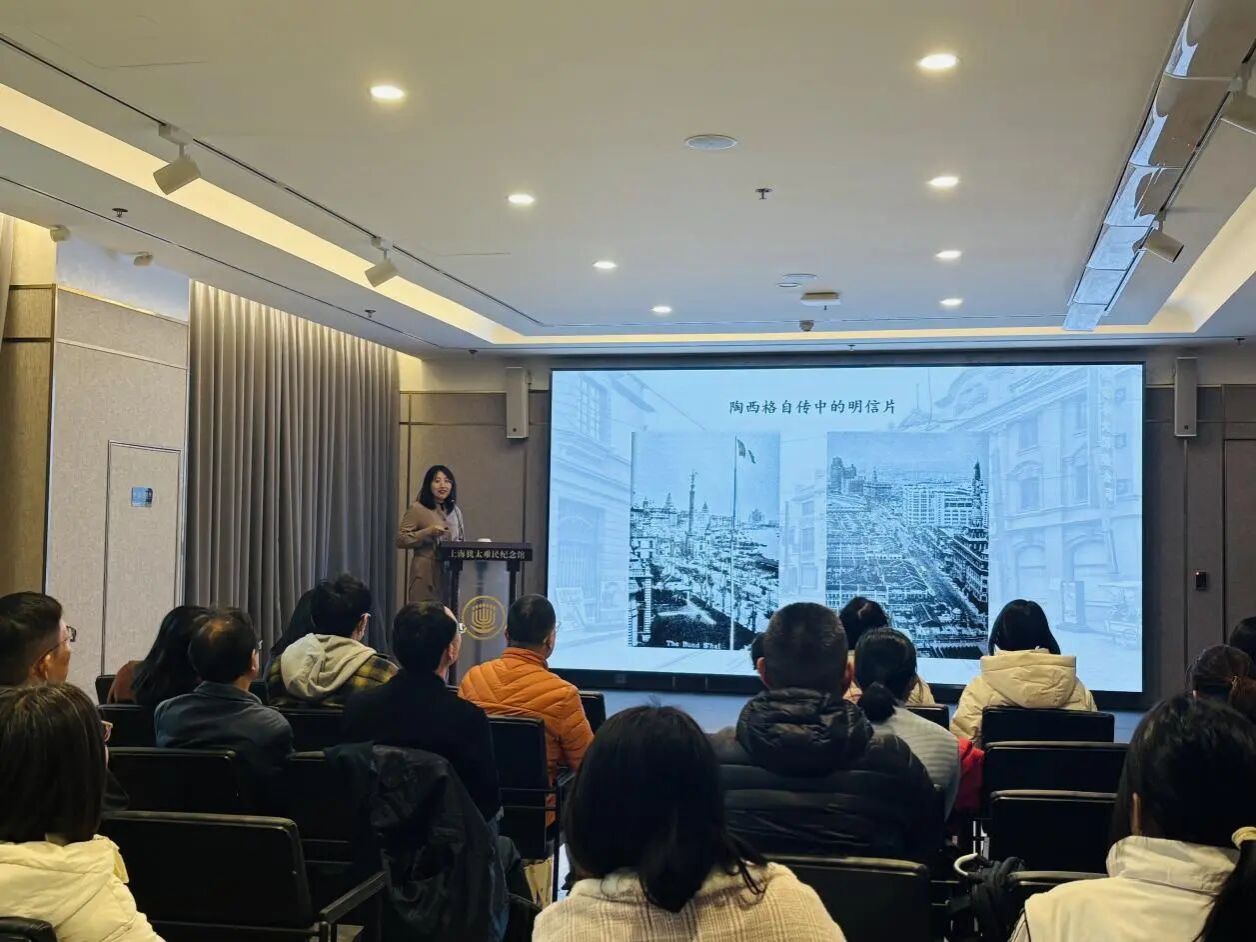
On December 12, 2025, the fifth session of the public lecture series “Jewish Exile Literature in Shanghai: Chinese Narratives and Contemporary Echoes”—titled “Literary Narratives of Jewish Exile in Shanghai and the City’s Urban Memory”—was successfully held at the Shanghai Jewish Refugees Museum.
The event was jointly hosted by the Research Center for Chinese Discourse and World Literature at Shanghai International Studies University (SISU), the Shanghai Jewish Refugees Museum, and the Shanghai Academy of Global Governance and Area Studies. Associate Professor Tang Jie from the School of European Studies at Xi’an International Studies University delivered the lecture, which was moderated by Dr. Zhang Tianzi (postdoctoral fellow) from the SISU Research Center for Chinese Discourse and World Literature. The lecture attracted a broad audience, including historians, literature enthusiasts, and members of the public.
Focusing on the Jewish refugee memoir Shanghai Passage, Flucht und Exil einer Wienerin and the novel Shanghai fern von wo by Ursula Krechel—the 2025 recipient of the Georg Büchner Prize—the lecture invited participants into an in-depth conversation about women’s writing and urban memory.
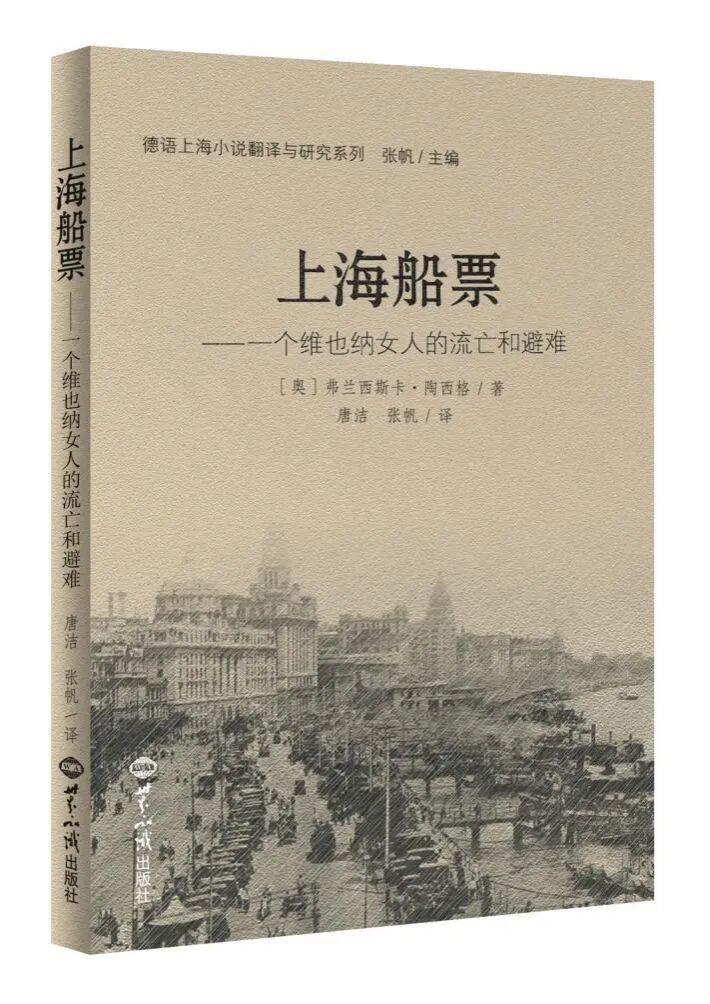
Shanghai Passage, Flucht und Exil einer Wienerin
Author: Franziska Tausig
Translators: Tang Jie; Zhang Fan
Publisher: World Affairs Press
ISBN: 978-7-5012-6443-8
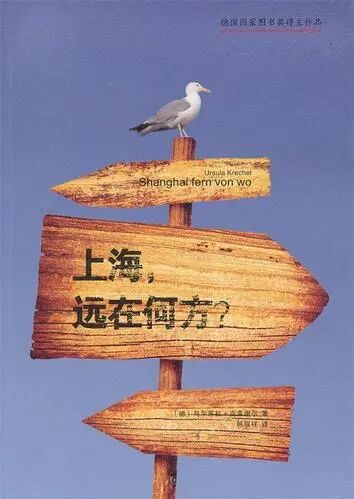
Shanghai fern von wo
Author: Ursula Krechel
Translator: Han Ruixiang
Publisher: People’s Literature Publishing House
ISBN: 978-7-0201-0047-7
“Shanghai Passage”: A Jewish Family’s Flight—and a City’s Welcome
At the beginning of the lecture, Tang Jie reviewed the historical context of more than 20,000 Jewish refugees from Germany and Austria who fled to Shanghai during World War II. Between 1938 and 1941—when many Western countries adopted restrictive immigration policies—Shanghai, with its open stance, became the refugees’ “last haven.” In order to commemorate their years in Shanghai, many survivors began writing about these unforgettable experiences after the war. To date, more than 30 Jewish refugee memoirs have been published, among which Shanghai Passage is one of the most influential.
After the 1938 “Kristallnacht” pogrom, Tausig and her husband, in desperate circumstances, discovered by chance two tickets to Shanghai for the ship Usaramo (name as recorded in the text). They spent everything to purchase the tickets, and their fate changed from that moment on. To make a living, Tausig worked in a Western restaurant, relying on her skill in baking Viennese Apfelstrudel. Later, she opened a “Welcome Bakery” in Hongkou, filled with the ambience of her hometown. In 1947, after eight years in Shanghai, Tausig left the city and returned to Vienna.
A Warm Narrative: From the “Kind Bread Uncle” to Friendship Across Borders
Unlike many narratives centered on the trauma of war, Tausig writes in a gentle, warm, and distinctly feminine voice, recording the kindness and comfort the city offered. Her husband often shared extra bread with neighborhood children and was affectionately called the “kind bread uncle.” Tausig also formed a deep friendship with a Chinese girl who was nicknamed “Nefertiti” (named after the ancient Egyptian queen). When news of Japan’s surrender arrived, Jewish refugees and Chinese residents poured into the streets together to celebrate victory. The bonds forged in hardship transcended ethnicity and nationality.
Drawing on a rich selection of excerpts and historical images, Tang Jie vividly recreated Shanghai as seen through the refugees’ eyes: from the skyscrapers of the Bund to Viennese-style cafés in the Hongkou–Tilanqiao area; from bustling Chinese markets to cabaret performances staged in hospital kitchens.
Literary Reconstruction: When Literature and History Mirror Each Other
Tausig’s real-life experiences also captured the attention of contemporary German writer Ursula Krechel, whose novel Shanghai fern von wo takes a resilient and optimistic woman—modeled on Tausig—as its protagonist. Together with Landgericht and Geisterbahn, the novel forms Krechel’s “Trilogy of Memory Novels,” which earned her the 2025 Georg Büchner Prize.
Tang Jie noted that, grounded in historical materials, Krechel employs an artistic method of weaving fact with fiction—enriching details through literary imagination and offering the characters a sense of healing. For instance, the novel invents an episode in which Tausig creates “spring rolls,” using this image of cultural fusion to symbolize how exiles reconstruct themselves through adaptation, and regain dignity through creation. Krechel is especially attentive to women’s shifting roles in exile, and she imagines scenes in which Tausig reads novels as a form of self-healing, thereby infusing a heavy history with warmth and strength. In this way, Shanghai Passage and Shanghai fern von wo form an intertextual dialogue across genres, together weaving a literary panorama of exile, survival, and memory.
Discussion and Q&A
During the interactive session, audience members engaged the speaker in discussion around challenges in translation, the distinctive perspective of women’s narratives, and the craft of blending fiction and historical reality in the novel. Through this exchange of ideas, participants deepened their understanding of the past and their reflection on this chapter of history.
Speaker Bio

Tang Jie is an Associate Professor and M.A. supervisor at the School of European Studies, Xi’an International Studies University, and an affiliated researcher at the Research Center for Chinese Discourse and World Literature, Shanghai International Studies University. Her research focuses on Sino-German literary and cultural relations. She has led multiple research projects, including National Social Science Fund projects, Humanities and Social Sciences Research projects of the Ministry of Education, and several provincial/departmental grants. She has published more than 20 academic papers in journals such as International Sinology, Journal of Dunhuang Studies, and Journal of Xi’an International Studies University, and two translated books. She also leads the National-level first-class undergraduate course Comprehensive German II.
This article is reposted from the Center for Chinese Discourse and World Literature Studies.
 Contact Us
 Become a Volunteer





 021-55133186
 info@shjews.com
 62 Changyang Road, Hongkou District